


The search engine as we have known it for over twenty years is undergoing a profound transformation. At the Google I/O 2026 conference1, Google unveiled a new generation of tools capable of transforming Search into a truly intelligent system driven by AI agents. The goal is no longer simply to answer a query or display a list of links, but to automate certain searches, continuously monitor the web, and provide contextualized answers in real time.
With this development, Google is clearly accelerating its transition toward a much more proactive search experience. Users are no longer just the ones asking questions; they are becoming supervisors of agents capable of exploring the internet on their behalf. This transformation likely marks one of the most significant changes in the history of the search engine since the advent of PageRank.

Google Search is becoming proactive
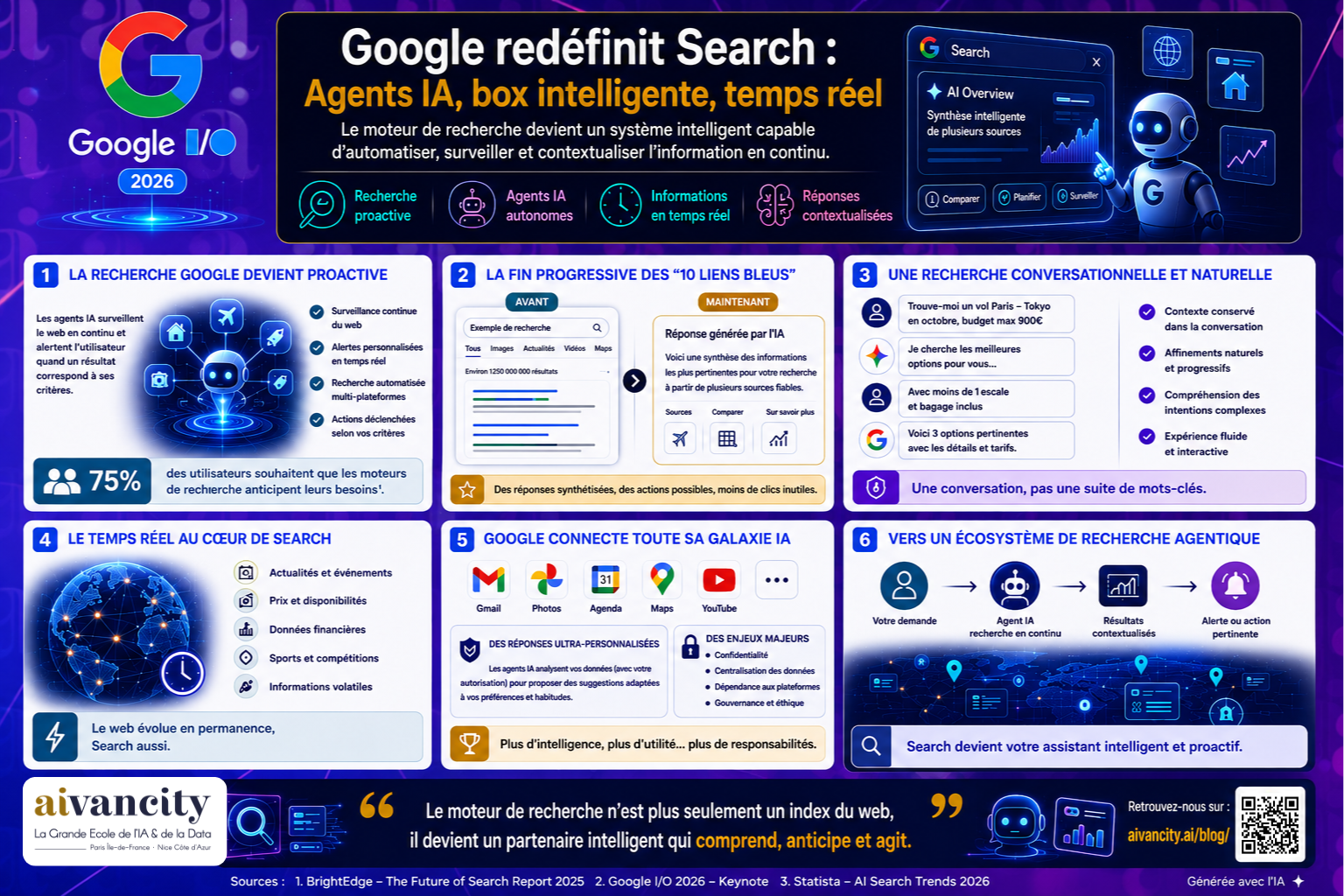
For years, Google operated on a relatively simple principle. Users would enter a few keywords and then browse through a series of links to find the relevant information themselves. This process is now gradually giving way to a much more conversational and automated system.

The new AI agents introduced by Google can perform continuous web searches without requiring constant user intervention. Instead of repeatedly running the same queries, the agent monitors the internet in the background and triggers an alert when a result matches the specified criteria.
Google presented several concrete examples. A user looking for an apartment near a train station with a specific budget could ask the AI agent to monitor new listings posted on various real estate platforms. The system would then automatically analyze the results and flag only the relevant listings.
The same logic applies to travel, events, concerts, and price comparison sites. AI is gradually becoming an active intermediary capable of continuously scanning the web.
The gradual disappearance of the “10 blue links”
One of the most noticeable changes involves the Search interface itself. Traditional lists of links are beginning to give way to smart boxes powered by artificial intelligence. These features no longer simply display results; they directly summarize information, cross-reference multiple sources, and sometimes suggest immediate actions.
Google is thus seeking to reduce the friction between searching for information and completing a specific task. Users no longer need to open multiple websites to compare offers, understand a topic, or plan a trip. AI is taking on an increasing share of the work involved in browsing and summarizing information.
This development brings Search closer to being an operational assistant capable not only of understanding user intent, but also of generating context-specific, actionable responses.
A much more natural conversational search experience
Google is placing a strong emphasis on the conversational aspect of its new AI systems. Users can now refine their queries naturally, without having to rephrase each request using technical keywords.
The AI agent retains the context of the conversation and can gradually adjust the results based on new information provided. A search thus becomes an ongoing conversation rather than a series of isolated queries.
This approach fundamentally transforms the user experience. The goal is no longer simply to “search the Internet,” but to interact with a system capable of understanding a complex need and acting accordingly.
Google is seeking to directly compete with the features popularized by ChatGPT, Perplexity, and Claude, where search becomes interactive, context-aware, and much more akin to a human conversation.
Real-time data is becoming central to search
The other major development announced by Google concerns real-time data processing. The new AI agents are capable of continuously analyzing the web in order to quickly incorporate the latest available updates.
This capability is particularly important for:
- news,
- prices,
- availability,
- events,
- or rapidly changing information.
Search engines are no longer just indexed databases of static web pages. They are becoming dynamic systems capable of tracking changes on the web almost continuously.
This approach requires massive data processing infrastructure and highlights the growing importance of generative AI2 in the evolution of modern search engines.




MasterAgent-Based AI
, with Claude Cowork
Move from conversational AI to operational AI. Automate your complex tasks in just two days—no technical skills required.
Google wants to connect its entire AI ecosystem
Google's ambitions extend far beyond simple web search. The company plans to gradually integrate its AI agents with Gmail, Photos, Calendar, and other services in its ecosystem.
This integration could enable highly personalized responses. For example, an agent could analyze:
- availability in a calendar,
- travel preferences,
- Gmail conversations,
- or purchasing habits,
in order to automatically provide tailored recommendations.
But this personalization also raises important questions regarding:
- confidentiality,
- data centralization,
- dependence on platforms,
- and the governance of AI systems.
The more effective agents become, the more they need broader access to users' personal data.
A new milestone in agent-based AI
Google's announcements highlight the rise of agent-based AI3. Unlike traditional conversational models, AI agents are capable of performing multi-step tasks in a semi-autonomous manner.
In the case of Search, this means that AI can:
- run searches,
- monitor sites,
- compare results,
- analyze data,
- and then summarize the information obtained.
This autonomy is gradually transforming search engines into systems capable of taking action rather than simply providing answers.
Google is thus joining a trend already evident at OpenAI, Microsoft, and Anthropic, where AI is gradually becoming an operational layer capable of interacting directly with the web and digital tools.
MasterAgent-Based AI
, with Claude Cowork
Move from conversational AI to operational AI. Automate your complex tasks in just two days—no technical skills required.
A strategic battle over the future of the web
Behind these announcements lies a much broader battle over control of access to information. For years, Google has organized the web by directing users to external sites. With AI agents, the company risks becoming a much more centralized intermediary between internet users and the internet.
This development is already causing concern among some players in the digital sector, particularly media outlets, content platforms, and websites that rely on Google traffic. If AI provides answers directly in Search, users may find themselves with less and less need to visit the source websites.
Search then becomes less of a navigation system and more of a closed environment driven by artificial intelligence.
Features that are still geographically limited
For now, Google’s new AI agents are primarily available in the United States. Some features are reserved for Google AI Pro and AI Ultra subscribers4 before a wider rollout in other regions.
This strategy shows that Google now views advanced AI as a key differentiator and a central component of its future business model. The most powerful features could gradually become paid services, particularly those that rely on AI agents performing time-consuming and computationally intensive tasks.
Search is entering a new era
With these announcements, Google is making it clear that the future of search is no longer just about a simple list of results. The search engine is gradually evolving into an intelligent platform capable of understanding, searching, monitoring, and taking action on users’ behalf.
This transformation could permanently change the way we access information on the Internet. The challenge will no longer be simply to find a relevant web page, but to collaborate with AI agents capable of continuously exploring the web to directly generate contextualized responses and actions.
The era of the traditional search engine seems to be gradually giving way to that of operational AI assistants.
How do AI agents work in Google Search?
Google Search’s new AI agents are based on an agent-based artificial intelligence architecture that combines a search engine, contextual analysis, and automated execution of web tasks. Unlike Google’s traditional approach, which relied on a simple list of links, these new systems are capable of interpreting complex user intent, autonomously crawling the web, and then synthesizing the results into a conversational and actionable format.
The system operates in several stages. First, the AI analyzes the user’s query to understand the actual need behind the search. It can then launch multiple web searches simultaneously, compare results, monitor certain information in real time, and generate a context-specific response. In some cases, the agent can continue working in the background to track the progress of a search without requiring further user input.
This approach combines natural language processing, real-time analysis, multi-step orchestration, and automated web navigation, gradually transforming Google Search into an intelligent assistance platform rather than a simple search engine.
- Proactive search: continuous web monitoring based on defined criteria
- Intelligent summarization: automatic grouping and summarization of information
- Conversational search: contextual understanding of user interactions
- Real-time analysis: rapid integration of newly available data
- Advanced personalization: tailoring responses to the Google ecosystem
- Smart boxes: displaying rich results directly in Search
- Task automation: comparing offers, tracking prices, or searching for events
- Simultaneous analysis of multiple information sources
- Maintaining a conversational context across multiple interactions
- Gradual refinement of results based on user feedback
- Tracking changes in information over time
- Production of ready-to-use summaries
- Orchestration of complex search tasks in the background
- Sign in with Gmail to provide context for certain searches
- Syncing events via Google Calendar
- Potential use of Google Photos content
- Integration with Google Maps for location-based results
- Integration with the Gemini ecosystem and Google's AI services
- Personalization based on user preferences and habits
- Risk of errors or hallucinations in certain analyses
- Reliance on the quality and reliability of web sources
- Significant centralization of user data
- High computational load associated with real-time processing
- Rollout remains limited depending on the country and subscription plan
- Regulatory Issues Related to AI Transparency and Governance
Learn more
Google Search’s evolution toward AI agents capable of acting in real time and coordinating multiple tasks simultaneously illustrates a profound transformation of search engines into true digital assistants. On a related topic, check out our article “Google is changing online browsing with ‘Auto Browse,’ the AI agent that surfs the web for you”, which analyzes how autonomous agents are redefining the way we search for, organize, and use information on the web.
References
1. Google. (2026). Google I/O 2026 Keynote and Product Announcements.
https://blog.google/
2. Google DeepMind. (2025). Generative AI Technologies and Applications.
https://deepmind.google/technologies/
3. McKinsey & Company. (2025). The Rise of Agentic AI: How Autonomous Systems Are Transforming Work.
https://www.mckinsey.com
4. Google One. (2026). Google AI Pro and Go.
https://one.google.com