


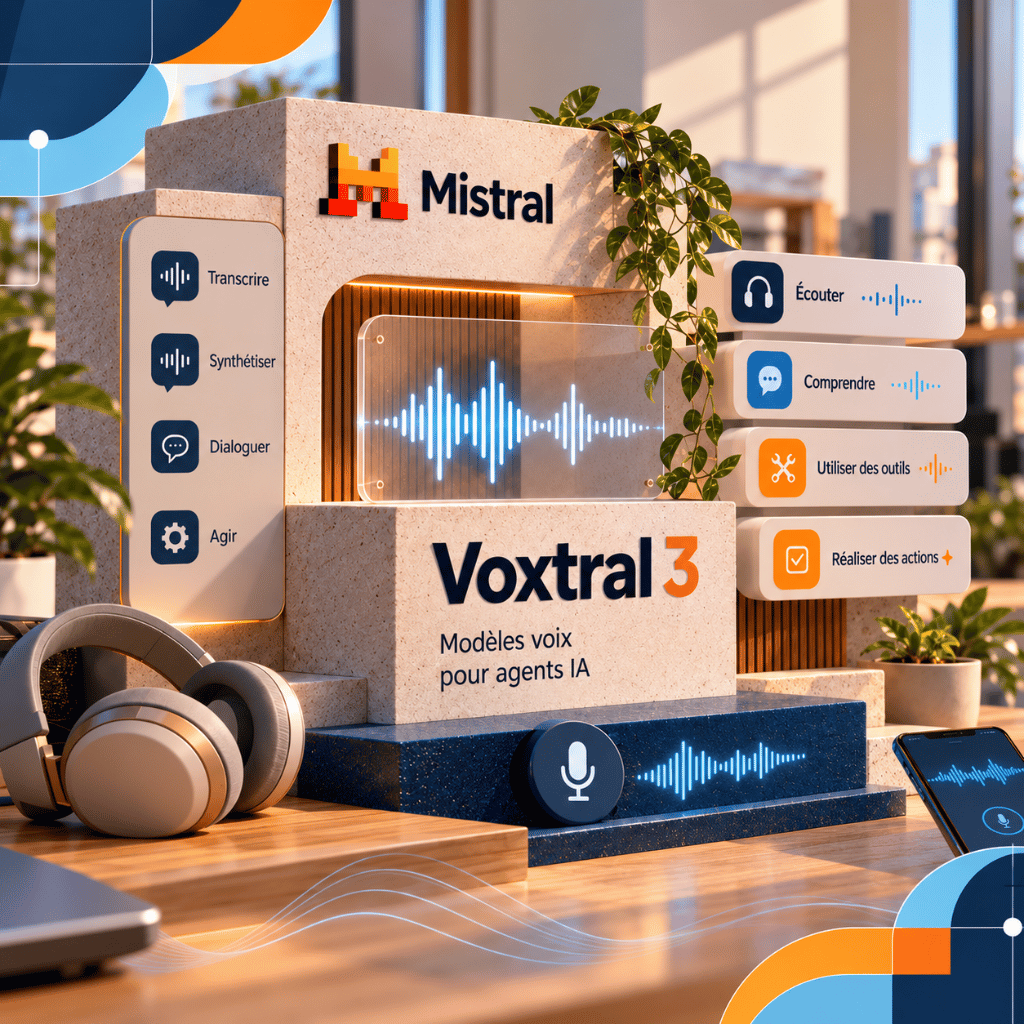
Presented by Mistral AI the October 20, 2026, Voxtral 3 combines several models of transcription and speech synthesis a development kit designed for agents capable of using tools during a conversation. So the novelty does not lie solely in the voice quality, but in the possibility of transforming a Oral discussion following actions taken on business systems. This development remains dependent on accent recognition, interruption handling, access security and human validation of sensitive operations.
What Just Happened
Mistral AI has launched Voxtral 3, a suite that includes offline and real-time transcription models, a text-to-speech model, and a voice agent SDK built on LiveKit. The suite is accessible via Mistral’s APIs and can also be deployed on private infrastructure, subject to terms to be discussed with the company.[1]
The product family offers several options. Voxtral Mini Transcribe 3 prioritizes cost and speed, Voxtral Small Transcribe 3 aims for superior accuracy, and Voxtral Mini Transcribe Realtime 3 processes continuous streams. Voxtral Speech 3 then converts the text to speech, while a general-purpose model handles reasoning and tool invocations.[1][2]
This architecture allows an agent to verify an invoice, view a file, search for information, or schedule an appointment during the interaction. It does not mean that the voice model makes all decisions on its own: success depends on the reasoning model, connectors, permissions, and confirmation rules.
What’s Really New
A transcription tool converts speech into text. A voice agent must perform a broader range of tasks: detect the beginning and end of a turn, interpret the user’s intent, retrieve data, select a tool, perform an action, and generate a voice response without unnecessarily interrupting the user.
Voxtral 3 organizes these steps into a continuous pipeline. The transcription model listens and detects the end of the turn; a general-purpose model processes the information and calls the appropriate tools; then the synthesis model responds. Mistral states that this parallel processing allows each turn to be completed in less than a second and enables the agent’s voice to be paused when the user resumes speaking.[1]
Modularity is a significant advantage. Each step is based on a separate component, which theoretically makes it possible to change the reasoning model, the voice, or the language without having to rebuild the entire system. This flexibility makes it easier to adapt to a specific line of business, but it also increases the number of potential points of failure and elements that need to be monitored.




MasterAgentic AI
with Claude Cowork
Move from conversational AI to operational AI. 2 days to automate your complex tasks — no technical skills required.
How does Voxtral 3 work
| Capacity or Constraint | Key Concepts to Understand |
|---|---|
| Transcription | Over 50 languages supported for batch models, with diarization, timestamps, and contextualized vocabulary. |
| Real-time | Transcription in under 500 ms reported for more than 35 languages in the benchmark described by Mistral, with turn-end detection. |
| Text-to-Speech | Over 35 languages and 50 dialects supported, with control over tempo, emotion, stress, and pronunciation. |
| Reasoning | A separate general-purpose model interprets the request, selects the tools, and constructs the response. |
| Actions | Function calls, web searches, and access to internal systems via authorized connectors. |
| Channels | SIP telephony, WebRTC browsers and applications, with integration into contact center tools. |
| Deployment | API available on European, U.S., or global endpoints, with private or on-premises options available to organizations. |
Contextualized vocabulary can improve the recognition of proper nouns or technical terms without the need for retraining. Dialog segmentation aims to identify different speakers. These features are useful in customer service, healthcare, and administrative services, but they must be evaluated for accents, background noise, speech overlap, and the actual vocabulary encountered.
The documentation also distinguishes between levels of language support. The 50 languages primarily pertain to file transcription. Real-time transcription and text-to-speech cover different sets of languages. It would therefore be misleading to present all features as equally available in more than 50 languages.[1][3]
Why This Matters to Organizations
Voice can serve as an interface for action when it bridges the gap between a request and a process. A technician can look up information without interrupting their work, a customer service representative can have an invoice verified during a call, and a patient can schedule an appointment without having to navigate through multiple screens.
The benefits go beyond convenience. A voice interface can improve accessibility for people who are not very familiar with software, have visual impairments, or are using a service in a situation where their hands and eyes are occupied. It can also handle simple requests before transferring the call to a professional.
However, the value depends on the completion rate, not just on the naturalness of the voice. An organization must measure transcription accuracy, the number of rephrasings, latency, tool errors, cost per resolved request, and the frequency of human intervention. A natural-sounding voice can mask an incorrect action with greater credibility than a text-based interface.


MSc Generative
and Agentic AI
Become an expert in generative and agentic AI: LLMs, transformers, enterprise deployment. Silicon Valley learning trip included. RNCP Level 7 certification (Bac+6).
What the results actually allow us to conclude
Mistral claims that Voxtral Small Transcribe 3 outperforms Whisper, Scribe v2, and Gemini 3.5 Transcribe in several multilingual and diarization tests. The company publishes evaluations on FLEURS, conversation corpora, and a speech recognition index from Artificial Analysis. It also claims to offer lower costs than several competing services for text-to-speech.[1]
| Statement | Published proof | Careful Reading |
|---|---|---|
| Multilingual transcription | Mistral results for 45 common languages in the FLEURS benchmark and several diarization tests. | An average score does not indicate consistent quality across every language, accent, or acoustic environment. |
| latency | Less than 500 ms for real-time transcription and less than one second per round in the announced pipeline. | Overall latency also depends on the network, the reasoning model, the tools, and the business systems. |
| Expressive Synthesis | Preference and instruction-following evaluations published in multiple languages. | Perceived naturalness does not measure the accuracy of the action or the fidelity across all voices and situations. |
| Pricing | Rates start at $0.0035 per minute for transcription and $0.04 per minute for an agent. | The final cost includes processing, tools, telephony, infrastructure, supervision, and human review. |
These results demonstrate credible technical progress, particularly in terms of language coverage, diarization, and continuous processing. However, they are not sufficient to demonstrate the reliability of a fully functional agent. A transcription benchmark measures word errors, whereas a professional agent must also understand intent, select the right tool, and refrain from acting when authorization is lacking.
Recent research on multilingual voice agents also shows that task success can vary significantly depending on the language, even when the conversation appears to flow smoothly. Future evaluations should therefore publish results by language and by scenario, rather than just an overall average.[5][6]
Voice, Personal Data, and Liability
A voice conversation may contain identity, health, payment, or location data. The deployment must specify where the audio is processed, whether it is retained, who can access the transcripts, and for how long. Hosting in Europe or on the organization’s own infrastructure provides an additional option, though it does not replace a policy of data minimization and access control.
Voice cloning and adaptation require explicit consent, a definition of authorized uses, and mechanisms for revocation. A realistic voice can improve accessibility or personalization, but it can also create a risk of identity theft if recordings, voice identifiers, or adapted models are not adequately protected.
Actions are the critical factor. An agent may view information with a moderate level of risk, but changing an appointment, confirming an order, or accessing a file has tangible consequences. Permissions must follow the principle of least privilege, operations must be logged, and irreversible or sensitive actions must require explicit confirmation.
The migration documentation also notes changes that may affect integrations, including the removal of word-level timestamps, the locking of settings after a session begins, and the unavailability of certain style instructions at launch. These technical limitations must be factored into pre-deployment testing.[4]
What to Watch for Now
The first question concerns independent evaluations. Voxtral 3 will need to be compared to competing systems under identical conditions, using the same network, the same tools, the same languages, and the same security rules. The task success rate will be more informative than a smooth demonstration.
The second concerns operational robustness: noise, accents, fast speech, multiple speakers, interruptions, poor connections, and ambiguous requests. A reliable agent must know how to rephrase, ask for confirmation, transfer the call to a human, and explain what they actually did.
The third issue concerns sovereignty. The option to use a European API or a private infrastructure provides organizations with more choices. Its actual value will depend on deployment conditions, licensing, required hardware, documentation, and the ability to audit the entire chain.
Voxtral 3 effectively brings the voice closer to an action interface, as the system integrates listening, reasoning, tools, and response into a unified pipeline. This evolution does not automatically transform every conversation into a reliable process. Maturity will be measured by the agent’s ability to perform a task in multiple languages, recognize its limitations, and allow the user to retain control.
Further Reading
To understand where Voxtral 3 fits into the evolution of speech understanding, real-time assistants and technological sovereignty , be sure to check out these analyses from the aivancity blog:
Sources
[1] Mistral AI. (October 20, 2026). Voxtral 3: Voice Agent SDK & Speech Models in 50+ Languages. View source
[2] Mistral AI. (2026). Audio Documentation: Overview of Models and Voice Agents. Accessed October 21, 2026. View the documentation
[3] Mistral AI. (2026). Languages supported by Voxtral 3 models. Accessed October 21, 2026. View specifications
[4] Mistral AI. (2026). Migrate from Voxtral 2, Technical changes and migration limitations. View the migration guide
[5] Mistral AI Research. (February 2026). Voxtral Realtime. View the scientific publication
[6] Hassid, M. et al. (September 2026). τ-Multilingual: Benchmarking Voice Agents Across Languages. View the study