


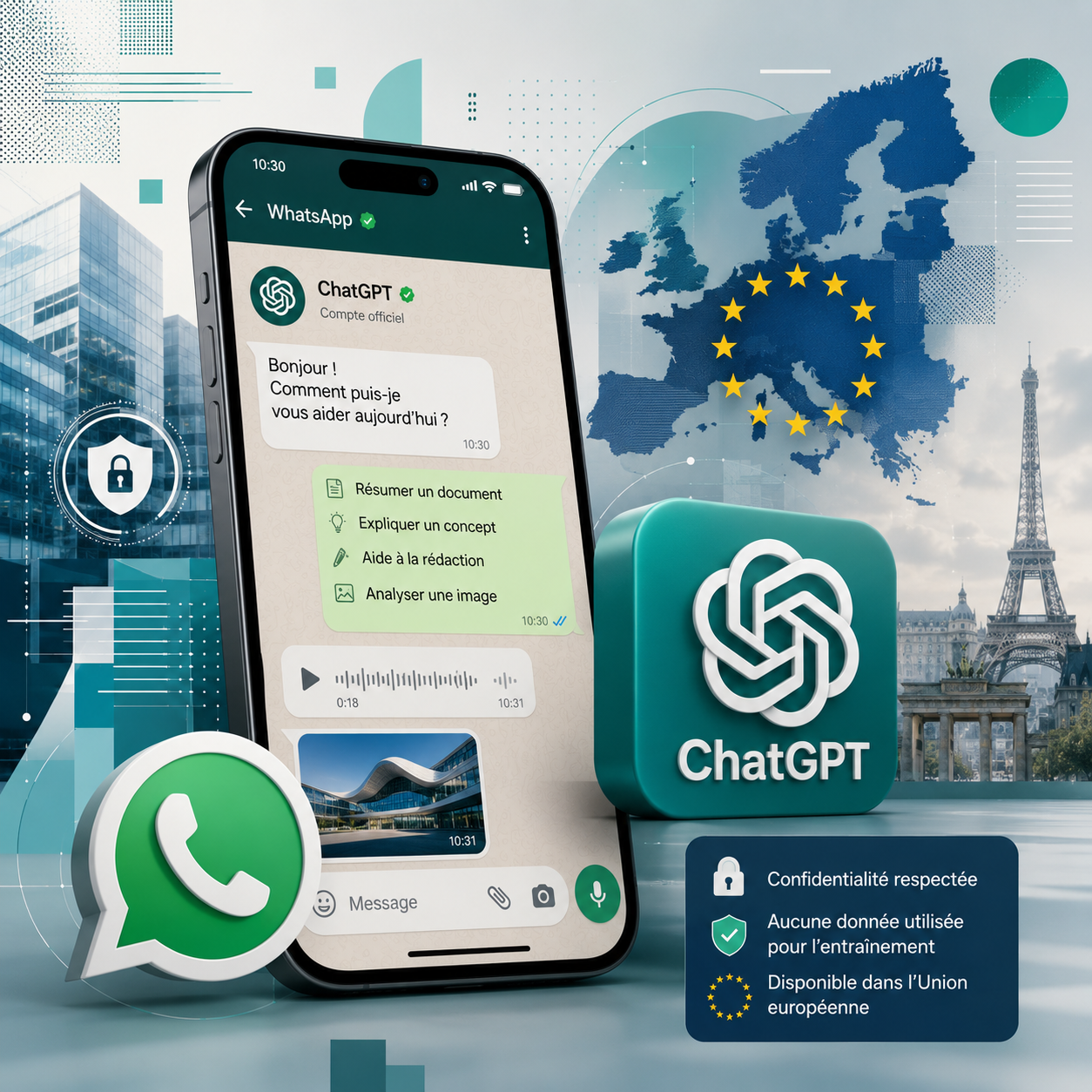
Artificial intelligence is steadily making its way into the apps we use every day. After search engines, office suites and smartphones, instant messaging apps have become a new battleground for the major AI players. It is against this backdrop that OpenAI has announced the return of ChatGPT on WhatsApp across the entire European Economic Area. After several months of interruption, European users can once again chat with the assistant directly from their messaging app, without going through the official ChatGPT app.1
This reopening goes well beyond the simple return of a feature. It illustrates the growing tensions between innovation, competition and digital regulation in Europe, where authorities are seeking to guarantee fair access to dominant platforms while protecting users.
ChatGPT finally returns to WhatsApp
For several months, European users had lost a particularly convenient way to access ChatGPT. Since January 2026, conversations with the assistant had no longer been possible directly in WhatsApp, forcing users to open OpenAI’s official app or use the web version.
This interruption stemmed from a change in the terms of use of WhatsApp Business, which restricted general-purpose conversational assistants’ access to the platform. The situation quickly raised questions, particularly because Meta AI, developed by WhatsApp’s parent company, remained available in the app.
After several months of discussions between Meta, OpenAI and European authorities, the situation is finally changing. Since July 13, 2026, ChatGPT has been gradually reactivated across the European Economic Area, allowing users to find the assistant directly in their everyday messaging app.2
Simplified use to reach as many people as possible
One of the main changes concerns ease of access. OpenAI is clearly seeking to democratize the use of its assistant by removing several barriers that existed before.
To start a conversation, all you need to do now is add the verified official contact “1-800-CHATGPT” in WhatsApp and send a first message. The chat starts exactly as it would with any other contact in the app.
Another important change: no ChatGPT account is required to start using the service. Users can ask questions, request explanations, send voice messages or share images directly from WhatsApp. Those who already have an OpenAI account can nevertheless link it to get higher usage limits and certain additional features, but this step remains entirely optional.1
This approach brings ChatGPT even closer to everyday use by eliminating the need to install an additional app or juggle multiple work environments.
A gradual rollout across Europe
Although the service has officially been relaunched, its rollout remains gradual. OpenAI says access depends in particular on the country of residence and the phone number associated with the WhatsApp account.
French users, like those in other European Union countries, may gradually see the service appear in the days following the announcement. This staggered rollout strategy allows OpenAI to ensure the stability of its infrastructure while handling the gradual increase in the number of users.
Unlike some launches reserved for the United States, this new version is offered directly to European users from the start of the rollout, confirming the strategic importance of the European market for OpenAI.


Master ChatGPT and
Generative AI
Demystify generative AI tools and unlock their potential in your field. A 100% hands-on approach, with no technical prerequisites.


Why had ChatGPT disappeared from WhatsApp?
ChatGPT’s removal was not the result of a technical problem, but of a policy change regarding access to the WhatsApp Business platform.
At the start of 2026, several competing conversational assistants lost the ability to operate directly on WhatsApp. The decision quickly drew criticism from several companies in the sector as well as from European authorities, who feared that such an arrangement would limit competition on a platform used every day by several hundred million Europeans.
The European Commission then took up the case as part of its work on large digital platforms. An initial solution proposed by Meta involved allowing competing assistants access through a paid model. Brussels, however, deemed this proposal insufficient.
The discussions ultimately led to a solution providing free, lasting access for compatible conversational assistants in the European Economic Area. The return of ChatGPT is thus one of the first concrete applications of this new regulatory direction.3
A new stage in the battle of AI assistants
The return of ChatGPT to WhatsApp goes far beyond the user experience. It is part of a much broader competition between the major artificial intelligence providers.
Users now spend a large share of their time in messaging apps. Being present directly in these environments allows AI assistants to become everyday tools rather than specialized apps opened only when needed.
OpenAI is thus following a trend already seen with Google and Gemini, Microsoft and Copilot, and Meta and Meta AI. The goal is no longer just to offer the most powerful model, but to integrate artificial intelligence into the tools users already check dozens of times a day.
This strategy could also encourage new uses. Users will be able to request translations, draft messages, summarize documents, analyze images or quickly get information without leaving their WhatsApp conversation.
Accessibility designed for the general public
The decision to make ChatGPT available without requiring an account is also a strong signal. OpenAI is seeking to reduce friction so that the assistant can be used as easily as a regular contact in the messaging app.
This simplicity could drive much broader adoption among users who have never used ChatGPT before. For OpenAI, WhatsApp is thus becoming a particularly strategic new acquisition channel thanks to its global reach.
Businesses could also benefit from this development. Teams will be able to quickly query ChatGPT during work conversations, generate ideas, rephrase a text or translate a message without switching apps.
The ethical stakes: AI moves into our everyday conversations
The return of ChatGPT to WhatsApp also raises several important questions about the privacy of conversations and data governance.
Although OpenAI points out that conversations are subject to its privacy policies, integrating artificial intelligence directly into a messaging app widely used for personal and professional exchanges calls on users to remain mindful of the information they share with these assistants.
This development also shows that European regulation now plays a decisive role in the artificial intelligence ecosystem. By imposing more open access conditions on dominant platforms, the European Union is seeking to preserve competition while giving users more choice.
A new win for integrating AI into everyday life
With the return of ChatGPT to WhatsApp, OpenAI is taking a new step in its strategy of integrating artificial intelligence into everyday use. The assistant becomes more accessible, easier to use and lands directly in the world’s most widely used messaging app.
Beyond this feature, the announcement reflects a deeper trend: tomorrow, artificial intelligence will probably no longer be a standalone app, but a capability seamlessly integrated into the digital tools we already use every day.
How does ChatGPT on WhatsApp work?
The return of ChatGPT to WhatsApp relies on an integration between OpenAI’s artificial intelligence models and Meta’s WhatsApp Business infrastructure. Unlike the ChatGPT app, which offers a full environment with history, custom GPTs and advanced tools, this version prioritizes quick access directly from the messaging app. Users interact with ChatGPT just as they would with any WhatsApp contact, without having to install an additional app or, in most cases, create an OpenAI account.
When a message is sent to ChatGPT’s official account, it is forwarded to OpenAI’s servers, where it is analyzed by the latest-generation language models. The assistant interprets the request, generates a response and sends it straight back into the WhatsApp conversation. The system also supports voice messages and images, making it possible to use ChatGPT’s multimodal capabilities directly from the messaging app.
Users who already have an OpenAI account can connect it to their WhatsApp conversation to get higher usage limits and access to certain additional features. Linking an account remains optional, however, as OpenAI has chosen to make its assistant available to as many people as possible through a particularly streamlined user journey.
The rollout of this integration also meets European regulatory requirements. After several months of suspension, ChatGPT is once again available in the European Economic Area thanks to changes in the conditions for accessing messaging platforms and a framework more favorable to competition between conversational assistants.
- Instant conversation: chat with ChatGPT directly from WhatsApp without switching apps
- Simplified access: usable without creating an OpenAI account, with optional linking for existing users
- Questions and assistance: answers on a wide range of everyday, professional or educational topics
- Multimodal support: send voice messages and images directly in the conversation
- Native integration: works just like a regular WhatsApp chat
- European rollout: gradual availability across the entire European Economic Area
- Cross-platform compatibility: access on the mobile and web versions of WhatsApp
- The rollout remains gradual, depending on the country and the phone numbers associated with WhatsApp accounts
- Some advanced features of the ChatGPT app are not yet available in WhatsApp
- Usage limits are higher for users who link their OpenAI account
- Response quality still depends on OpenAI’s models and the information available at the time of the request
- Like any language model, ChatGPT can produce factual errors or hallucinations and requires verification for critical uses
- Users should remain cautious when sharing sensitive information in a messaging app, even a protected one
Learn more
The arrival of ChatGPT on WhatsApp in the European Union confirms the major AI players’ determination to integrate their assistants directly into the messaging apps people use every day. On a related topic, check out our article “Meta Wants to Make Its AI More Discreet with Incognito Chat on WhatsApp”, which examines how platforms are trying to reconcile artificial intelligence, conversation privacy and new conversational experiences.
References
1. OpenAI. (2026). ChatGPT on WhatsApp.
https://help.openai.com
2. OpenAI. (2026). Using ChatGPT in WhatsApp.
https://help.openai.com/en/articles
3. European Commission. (2026). Digital Markets Act and Messaging Platform Interoperability.
https://digital-markets-act.ec.europa.eu